How the World’s Leading Sports Organizations Are Monetizing Far More Than Live Games
The growth of owned platforms, historical archives, digital content, and direct fan relationships is creating new opportunities for clubs, leagues, and federations.
Few content categories have navigated media fragmentation as successfully as live sports.
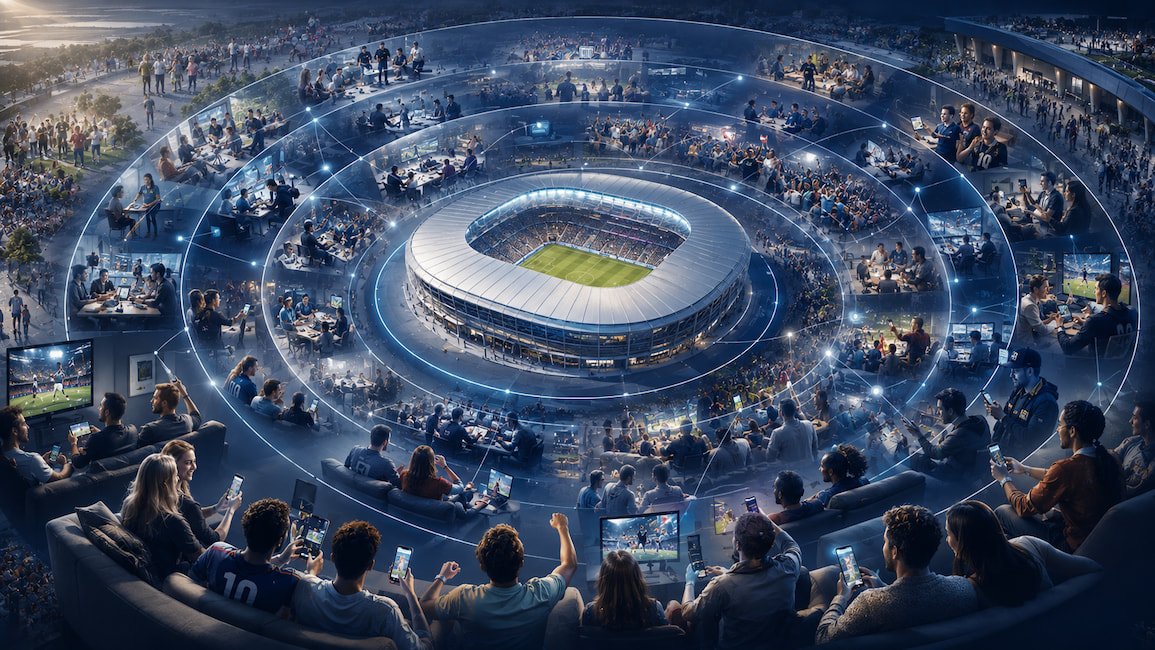
At a time when audiences move constantly between platforms, devices, and formats, major sporting events continue to achieve something increasingly rare: bringing millions of people together around the same experience at the same moment.
The numbers reflect that reality. The NFL has signed media agreements worth more than $110 billion. The NBA recently secured a new rights cycle estimated at approximately $77 billion. The Premier League continues to renew multi-billion-dollar broadcasting deals, while Formula 1, the UEFA Champions League, UFC, and other premium sports properties continue attracting companies such as Amazon, Apple, Netflix, YouTube, and DAZN.
Sports rights remain among the most valuable assets in the global media industry. Yet another trend is unfolding at the same time.
While rights values continue to grow, the economics behind the market are changing. According to analyses from Ampere Analysis and S&P Global Market Intelligence, spending on sports rights in the United States has grown roughly five times faster than the broader television market over the past decade. As a result, traditional broadcasters face increasing pressure as they compete for increasingly expensive properties while dealing with subscriber losses, audience fragmentation, and changing viewing habits.
For leagues, federations, and rights holders, this creates both an opportunity and a challenge. Sports continue to attract record investment, but few industry executives believe future growth can rely exclusively on successive increases in media rights fees. The search for new revenue streams, deeper fan engagement, and more direct audience relationships has become a strategic priority for the industry’s most forward-thinking organizations.
Against this backdrop, clubs, leagues, and federations have begun investing more heavily in areas that historically played a secondary role in their strategies: owned platforms, content operations, historical archives, digital products, membership programs, and direct-to-fan initiatives.
This does not represent a replacement of the traditional model. Media rights remain the primary economic engine of the sports industry. What has changed is the recognition that a game produces far more than a live broadcast. It generates stories, personalities, images, data, memories, and context. It creates assets capable of driving audience engagement, second-screen conversations, and revenue long after the final whistle.
For decades, sports monetized scarcity, but now industry’s most advanced organizations are learning how to monetize abundance as well.
Formula 1 expanded the value of the race by building a media operation around it
The transformation of Formula 1 under Liberty Media is one of the most visible examples of this shift.
When Liberty acquired the series in 2017, it inherited a globally recognized property with strong commercial foundations but a relatively limited relationship with fans outside race weekends.
Over the years that followed, Formula 1 invested heavily in digital expansion, direct-to-consumer distribution, social growth, and content creation.
The most visible outcome was Drive to Survive. More than a marketing initiative, the Netflix series demonstrated how personalities, rivalries, and behind-the-scenes access could dramatically expand the reach of a sports property. It did not replace the core product. It created new entry points into it.
Millions of viewers who had never followed Formula 1 became interested in the championship through its stories before becoming interested in its races.
At the same time, Formula 1 expanded F1 TV and strengthened its direct relationship with fans. According to Liberty Media, subscriptions to the service grew 20% in 2025. Reuters reported that the sport reached a cumulative audience of 1.83 billion viewers in 2025, its highest figure in five years, while its global fan base grew to 827 million people.
The race remains Formula 1’s flagship product, of course. The difference is that it now sits within a permanent ecosystem of content, distribution, storytelling, and fan engagement.
The NFL understood decades ago that memory creates value
Long before the streaming era, the NFL was already treating content as a strategic asset.
NFL Films, founded in the 1960s, developed a distinctive style that transformed games into narratives. Through documentaries, feature productions, original programming, and historical storytelling, it helped shape the cultural identity of American football.
The NFL describes its archive as the largest sports film and video collection in the world. More important than its size, however, is how it is used.
Historical footage continues to fuel documentaries, licensed productions, sponsored content, original series, and editorial projects decades after the games themselves took place.
NFL+ extends the same philosophy into the direct-to-consumer space. The platform combines live games, condensed versions, full replays, archival content, and exclusive programming. When the league negotiated parts of its media portfolio with ESPN, it retained control over NFL+, NFL Films, NFL.com, team websites, and key digital assets.
That decision says a great deal about how the league views its future. The NFL season lasts only a few months, but clearly the opportunity is to engage with fans all year.
Direct relationships have become strategic assets
The push toward direct audience relationships is visible across the industry.
NBA League Pass, F1 TV, NFL+, UFC Fight Pass, FIFA+, and UEFA.tv operate under different business models, but they share a common objective: reducing the distance between rights holders and consumers.
The NBA was one of the earliest organizations to embrace this approach.
League Pass initially served as a way for out-of-market fans to access games. Over time, it evolved into something much more valuable: a platform capable of generating insights into consumption habits, engagement patterns, and fan behavior.
In the NBA’s most recent media agreements, the league maintained the NBA App as a central access point to its broader ecosystem. In an increasingly fragmented media environment, owning the gateway to the audience has become strategically important.
The same logic can be seen in initiatives such as Real Madrid’s RM Play and Liverpool’s All Red membership ecosystem. Both combine premium content, documentaries, full-match replays, exclusive experiences, and membership benefits around authenticated audiences.
For decades, clubs and leagues focused on selling audience reach. Increasingly, they are focused on understanding that audience as well.
Archives are no longer cost centers
The growing importance of sports archives provides another signal of this transformation.
The Premier League has made matches dating back to the 1992/93 season available through its digital platforms and continues to invest in archive management and licensing through partnerships such as IMG Replay. Historic matches, iconic goals, and memorable moments continue generating value through documentaries, sponsored content, international distribution, and special programming.
Major League Baseball has gone even further with MLB Film Room, which allows users to search, filter, view, and share millions of clips, including footage dating back nearly a century. The archive functions not simply as a repository but as an editorial and commercial resource.
The history of MLB Advanced Media reinforces the same point. Originally created to coordinate the league’s digital presence, the operation developed capabilities in streaming, content distribution, and media management that eventually led to the creation of BAMTech, later acquired by Disney in a multi-billion-dollar transaction.
The value was not only in the content itself, but in the ability to organize it, find it, and distribute it at scale.
Clubs are building media organizations
This transformation is equally visible at the club level.
Through City Studios and City+, Manchester City has built an operation capable of producing documentaries, original series, interviews, podcasts, behind-the-scenes content, and premium programming for audiences across multiple markets.
According to the club’s annual report, Together: Treble Winners generated more than 11 million streams and reached 2.6 million unique viewers globally.
These initiatives respond to a simple reality: a major club’s digital audience is significantly larger than its stadium audience.
Content is no longer produced simply to fill social media feeds, it supports membership programs, creates new sponsorship opportunities, strengthens global fan relationships, and extends the value of the club beyond matchdays. The Premier League’s decision to internalize its international production and distribution operations beginning with the 2026/27 season reflects the same trend. Greater control over content, archives, audience data, and distribution is becoming increasingly strategic.
Brazil already has the audience, but how much value does it captures?
Few markets combine sporting passion and digital engagement as effectively as Brazil.
According to IBOPE Repucom, Flamengo surpassed 67 million social media subscriptions in 2026. Corinthians, Palmeiras, São Paulo, and other major clubs have built digital audiences that rival some of the world’s largest sports brands.
Recent initiatives suggest that the development of owned media channels is already underway.
Flamengo has expanded international YouTube broadcasts. Corinthians has grown Corinthians TV. Palmeiras has integrated media assets into sponsorship strategies. Atlético Mineiro invested in a new multimedia studio. Fluminense restructured FluTV, expanding both production and programming.
These examples demonstrate that owned media is no longer a novelty in Brazilian sports.
The next challenge is less about launching new channels and more about integrating existing initiatives into broader strategies involving data, archives, distribution, membership, and monetization.
This challenge becomes even clearer when considering the structure of many Brazilian membership programs. Most remain heavily focused on ticketing benefits, while millions of supporters live hundreds or even thousands of kilometers away from their clubs.
The opportunity extends far beyond access to stadiums.
The Brazilian Football Confederation (CBF) may represent the most compelling example. Few organizations in world sports control a history as rich or a fan base as globally distributed. Five World Cup titles, generations of iconic players, decades of competition, youth national teams, and women’s football create an extraordinary audiovisual asset.
The value is clearly there, but how much of that value is organized, accessible, and consistently monetized?
The next challenge is learning to operate abundance
The examples of Formula 1, the NFL, the NBA, the Premier League, MLB, and Manchester City all point in the same direction.
Live sports remain the most valuable asset in the industry.
But the organizations leading the sector have stopped relying exclusively on that asset for growth.
Their focus increasingly includes owned platforms, direct audience relationships, historical archives, original content, and new forms of distribution.
Monetizing abundance requires capabilities that differ from those needed to monetize scarcity. It requires organizing archives, locating content quickly, distributing it across multiple platforms, integrating sponsors into editorial experiences, and building direct relationships with audiences.
The world’s most advanced sports organizations remain sports organizations.
What is changing is how they operate.
Many now function increasingly like media companies because they recognize the economic value created between events, not just during them.
The game remains at the center of the ecosystem, but the ecosystem itself is becoming much larger.
Keep the next idea close.
Perspectives, projects and ideas on the technologies shaping modern media operations.