Production Automation: Finding Efficiency in a Market That Needs to Do More with Less
A conversation that gained traction at SET Regional Centro-Oeste
During the SET Regional Centro-Oeste, a Brazilian industry event held in Brasília on March 18, one topic kept coming up in conversations with broadcasters, production companies, and media organizations: how to scale audiovisual production without proportionally increasing operational costs.
For those who were not there, it is worth sharing a few key takeaways. The discussion connects directly to production automation and to a broader shift in how many organizations are structuring their workflows.
More content demand, limited room to increase costs
Audiovisual production is expanding rapidly. Live productions, sports coverage, digital content, hybrid events, and multi-platform formats have significantly increased the volume of content that needs to be produced every day.
At the same time, few organizations are in a position to expand teams or make large infrastructure investments.
This reflects a structural shift in the role of broadcasters. Many organizations no longer operate as traditional TV channels. They are now acting as media houses, producing content simultaneously for broadcast, digital, streaming, and social platforms.
Production is no longer linear. The same content needs to exist in multiple formats and reach different platforms at the same time. Live shows, digital formats, and social content now coexist within the same production environment.
This is one of the reasons production automation is back on the agenda.
For years, automation solutions were designed mainly for large studio environments. They were reliable and robust, but often built around heavy CAPEX models, significant hardware requirements, and complex implementation processes.
For many operations, especially mobile productions or smaller teams, that model has been difficult to justify.
Automation as an efficiency tool
Today, automation is increasingly seen as a way to improve operational efficiency.
In a traditional studio setup, it is common to have four or five professionals operating cameras, switchers, graphics, teleprompters, and playout systems from the control room.
Modern automation platforms allow part of this workflow to be centralized, enabling smaller teams to operate productions with the same level of quality.
Beyond simplifying operations, automation also creates an opportunity to increase production output.
When workflows become more structured and predictable, organizations can produce more content within the same day or week, using essentially the same infrastructure.
In this context, production infrastructure evolves from a technical environment into a content engine, capable of supporting continuous output across multiple platforms.
A more flexible approach to production automation
This is the context in which we presented the Cuez solution during SET Regional Centro-Oeste.
The platform was designed with a clear objective: to offer production automation in a more accessible and flexible way than many traditional solutions.
The idea is to automate workflows using infrastructure that is already in place.
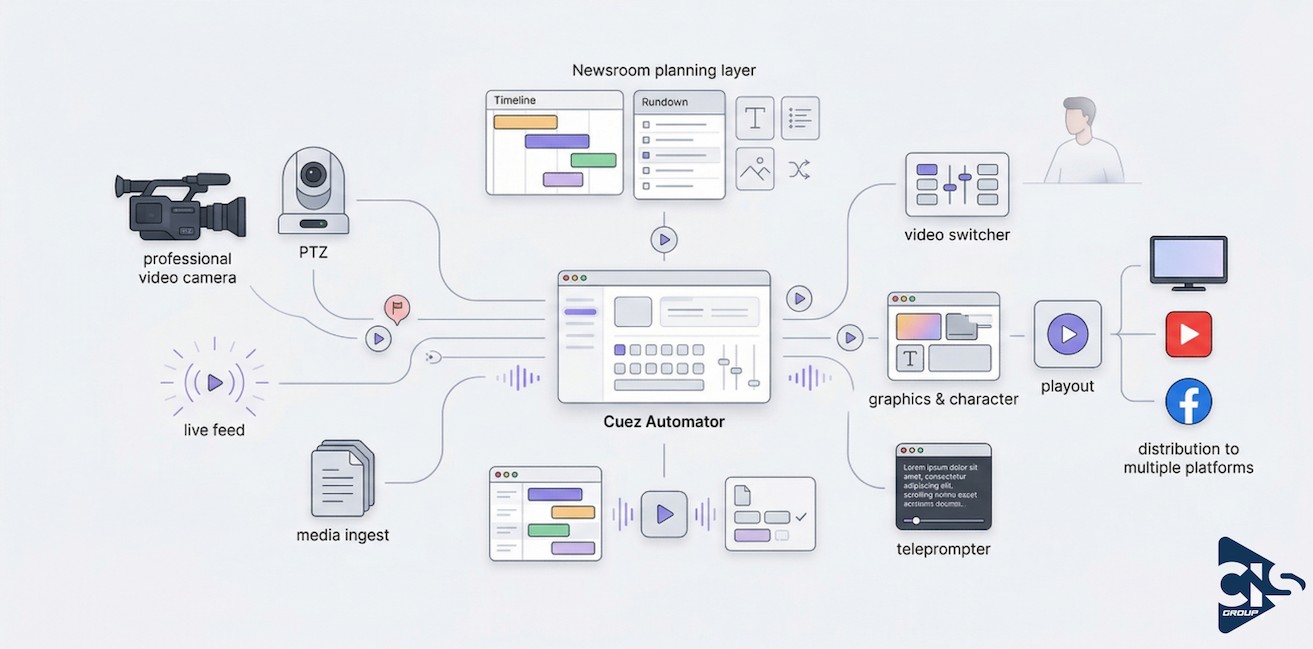
Cuez works as an orchestration layer, coordinating different devices within the production environment, including:
- cameras from multiple manufacturers, including robotic and PTZ systems
- production switchers used in both broadcast and digital environments
- teleprompter systems
- character generators
- playout servers
- integration with newsroom systems
This level of integration helps teams run more structured and predictable workflows, while reducing manual intervention during live operations.
Deployment flexibility
Another important aspect is the deployment model. Cuez operates as a SaaS platform, and can be deployed either in the cloud or on-premises, depending on each organization's requirements.
This reduces barriers to adoption and allows the solution to scale alongside the operation.
For many organizations, this flexibility plays a key role in technology decisions.
Automation and the future of audiovisual production
The media industry will continue to operate in an environment where producing more content is no longer optional.
In this environment, automation becomes part of the operational strategy, not just a technical choice.
Organizations that can structure more efficient workflows will be better positioned to meet growing demand without increasing costs at the same pace.
That was the core of the discussion at SET Regional Centro-Oeste, and it is a topic that will continue to shape conversations about the future of production.
For those interested in exploring this further, we will also be presenting the Cuez platform at NAB Show 2026 in Las Vegas.
If you would like to understand how production automation can fit your operation, our team will be glad to continue the conversation.
Keep the next idea close.
Perspectives, projects and ideas on the technologies shaping modern media operations.